March 30, 2026
In the lush, subtropical landscape of New Orleans and Jefferson Parish, trees are more than just landscaping; they are historical monuments. From the sprawling Southern Live Oaks of City Park to the towering Bald Cypresses guarding our wetlands, our canopy is world-renowned.
However, living in a region with 60+ inches of annual rainfall and stifling humidity comes with a cost: it is a paradise for fungi.
Key Takeaways
- The “Invisible” Failure: A tree can maintain a lush, full canopy of green leaves while its internal structural integrity is compromised by up to 70%.
- The Primary Culprit: Fungi are the main agents of decay, digesting the structural components of wood (lignin and cellulose), often entering through unsealed wounds.
- The CODIT Defense: Trees do not heal; they “compartmentalize” or seal off decay. Understanding this biological process is crucial for proper pruning.
- Human Error: The vast majority of urban tree decay starts with human mistakes bad pruning (flush cuts), lawnmower damage, and “mulch volcanoes.”
- The “Thud” Test: A simple-sounding test with a mallet can reveal hollows. A solid tree sounds crisp; a decaying tree sounds like a drum.
- Regional Risks: In New Orleans, our high water table and humidity make trees exceptionally prone to root rots like Ganoderma and Armillaria.
At A Perfect Cut Tree Service, the most difficult conversations we have with homeowners usually happen after a storm. A massive limb has snapped, or an entire tree has uprooted, crushing a fence or a roof. The homeowner is often baffled: “But it looked so healthy! It was green! It didn’t look sick.”
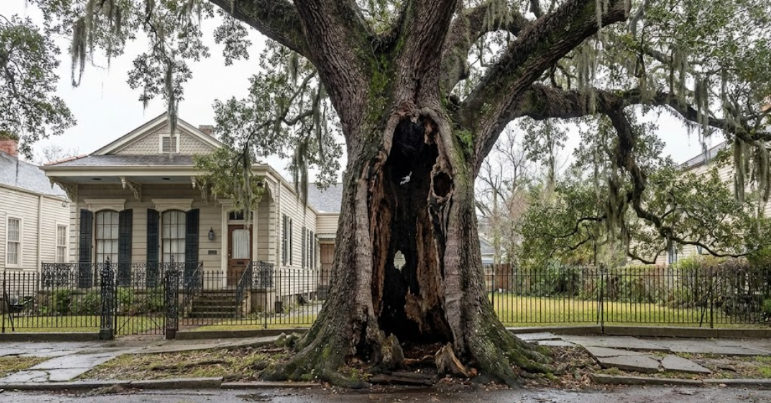
When we inspect the failure, the story is almost always written in the wood. The center of the trunk, the heartwood, is gone. It has been replaced by a soft, spongy pulp or a hollow void. The tree was structurally failing for years, perhaps decades, but because the vascular system (which transports water to the leaves) is on the outside of the trunk, the canopy remained green until the very end.
What Really Happens When a Tree Rots
To understand how to prevent decay, you must first understand what it is. Wood decay is not an illness in the traditional sense; it is a digestion process.
Trees are composed primarily of two complex chemical substances:
- Cellulose: Long chains of sugars that give wood its flexibility and tensile strength (ability to bend without breaking).
- Lignin: A complex organic polymer that acts like glue, giving wood its rigidity and compressive strength (ability to stand tall without buckling).
Wood decay fungi are specialized organisms that release enzymes to break down these compounds for food. As they eat the cellulose and lignin, the wood loses its strength.
White Rot vs. Brown Rot
Not all rot is the same. Arborists generally classify decay into two main categories based on what the fungus is eating:
- White Rot: These fungi digest both lignin and cellulose. The remaining wood becomes soft, moist, and stringy. It often appears bleached or whitish. This is dangerous because the wood becomes “mushy” and loses its ability to hold weight.
- Brown Rot: These fungi primarily digest cellulose but leave the lignin behind. The wood turns dark brown, dry, and brittle. It tends to crack into cube-like chunks (cubical rot). Brown rot is particularly dangerous because it causes the wood to lose its flexibility. A tree with brown rot may not sag or look weak; it will simply snap cleanly and suddenly during a wind gust.
How Trees Defend Against Decay Using the CODIT Model
This is the most important concept for any homeowner to understand. Trees do not heal. If you cut your skin, your body generates new skin cells to replace the damaged ones. If you cut a tree, it cannot grow back the missing wood. Instead, it attempts to seal the wound to stop the infection from spreading.
This defense system is called CODIT (Compartmentalization of Decay in Trees), a biological model developed by plant pathologist Alex Shigo that explains why trees don’t heal, but instead form chemical boundaries to wall off infections. When a tree is wounded, it creates four chemical “walls” to trap the fungus:
- Wall 1 (Top/Bottom): The tree plugs the vascular tubes above and below the wound to stop the vertical spread of decay.
- Wall 2 (Inward): The tree deposits chemicals in the growth rings to stop the decay from moving deeper into the center.
- Wall 3 (Lateral): The ray cells (which run radially like spokes on a wheel) form a chemical barrier to stop the decay from spreading sideways around the trunk.
- Wall 4 (The Barrier Zone): This is the new wood the tree grows after the injury. It separates the old, infected wood from the new, healthy wood. This is the strongest wall.
The Takeaway: If a tree is healthy, it can successfully “wall off” the rot. The decay will be trapped in a small pocket, and the tree will continue to grow around it. If the tree is stressed or if the wound is too large, the walls fail, and the rot spreads throughout the entire trunk.
The “Big Three” Decay Pathogens in Louisiana
While there are thousands of fungal species, a few specific “bad actors” cause the majority of the tree failures we see in the New Orleans metro area.
1. Ganoderma (The Butt Rot)
If there is one fungus you need to know, it is Ganoderma.
- Appearance: It produces a large, shelf-like mushroom (conk) at the base of the tree near the soil line. It is often reddish-brown on top with a creamy white underside and feels hard, almost like wood or plastic.
- The Danger: Ganoderma causes ‘butt rot’ — decay of the lower trunk and structural roots. According to the University of Florida’s Institute of Food and Agricultural Sciences, by the time you see the conk, the fungus has likely already destroyed a significant portion of the tree’s anchoring system. There are currently no cultural or chemical controls for preventing or curing the disease once a tree is infected.
- Susceptible Trees: Live Oaks, Water Oaks, Maples, and notoriously, Palms (Ganoderma zonatum).
2. Hypoxylon Canker
Hypoxylon is a stress-opportunist. It doesn’t usually attack a perfectly healthy tree; it waits for a tree to be weakened by drought or root damage.
- Appearance: It does not look like a mushroom. It appears as a crusty, silver-grey, or black patch that looks like burnt asphalt or tar. You will often see the bark sloughing off to reveal this fungal mat underneath.
- The Danger: Once Hypoxylon sets in, the tree’s structural integrity degrades very rapidly. The wood becomes brittle, leading to “sudden limb drop.” In our experience, once a tree shows significant Hypoxylon, removal is usually the only safe option.
3. Armillaria (Shoestring Root Rot)
Armillaria attacks the root system, often moving from a dead stump to a living tree underground.
- Appearance: In late autumn, you may see clusters of honey-colored mushrooms popping up around the base of the tree. If you peel back the bark at the soil line, you might see white fungal fans or black, shoestring-like strands (rhizomorphs).
- The Danger: This is a root killer. A tree with advanced Armillaria may look stable, but it can uproot completely in a moderate wind because its anchor roots have turned to mush.
How to Detect Hidden Tree Decay
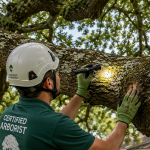
Since we cannot see inside the tree, how do arborists determine if a tree is safe or if it is a hollow shell? At A Perfect Cut Tree Service, we use a graduated diagnostic approach.
1. Visual Inspection (The Clues)
The tree often tells us where the problems are if we know where to look.
- Conks: As mentioned, mushrooms are the “fruit” of the fungus. If you see a fruit, there is a body (mycelium) eating the wood inside.
- Cavities and Nesting Holes: Birds and squirrels don’t dig holes in hard, sound wood. They excavate wood that is already soft and decayed. A nesting hole is a confirmation of internal rot.
- Seams and Cracks: Long vertical cracks in the bark often indicate that the tree is physically splitting due to internal pressure or hollows.
- Carpenter Ants: We often hear customers say, “Ants are eating my tree!” Myth Buster: Carpenter ants do not eat wood; they build nests in it. They only nest in wood that is already decayed. They are a symptom, not the cause.
2. The Mallet Test (Sounding)
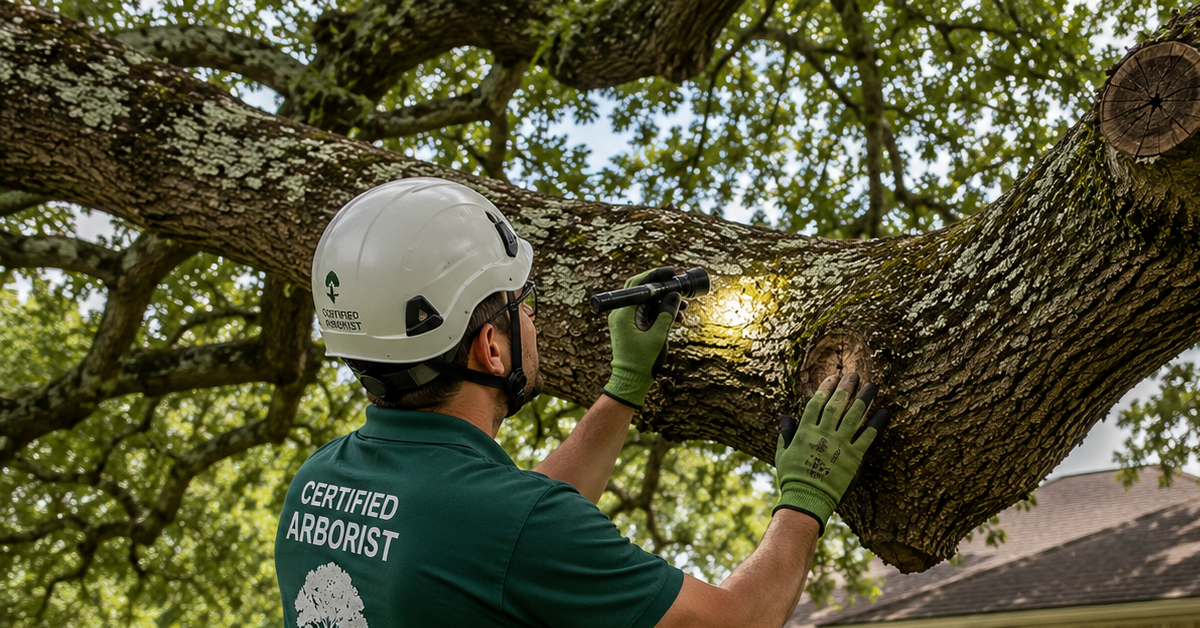
This is a low-tech but incredibly effective tool. We use a hard rubber mallet to firmly tap the trunk at various points.
- Solid Wood: Produces a sharp, crisp “thud” or “ping.” The hammer bounces back quickly.
- Decayed/Hollow Wood: Produces a low-frequency, drum-like “thump.” The impact feels dead or dull.
- Try this at home: Tap your tree. If the pitch drops significantly in one area, you likely have a void behind the bark.
3. Advanced Technology: The Resistograph
For high-stakes trees (like a massive oak leaning over a nursery), guessing isn’t enough. We may use resistance drilling.
- How it works: A specialized drill drives a micro-needle into the tree.
- The Data: The machine measures how much resistance the wood offers. Sound wood resists the drill; decayed wood offers no resistance.
- The Result: We get a graph (like an EKG for a tree) that shows us exactly how many inches of solid shell wall exist.
How Homeowners Accidentally Cause Tree Decay
While storms and lightning cause wounds, the vast majority of decay in urban trees is self-inflicted by humans. We kill our trees with “kindness” and bad maintenance habits.
The “Flush Cut” Disaster
For decades, people thought cutting a branch flush against the trunk was the “neatest” way to prune. This is wrong. At the base of every branch is a swollen area called the Branch Collar. This collar contains the specialized cells the tree needs to seal the wound (Wall 4 of CODIT).
- The Mistake: When you cut flush to the trunk, you cut off the collar. You have removed the tree’s immune system. The wound cannot seal, and rot enters directly into the main trunk.
- The Solution: Always cut just outside the collar, leaving the swollen bump intact.
Lawnmower Blight (Basal Rot)
This is the number one killer of young trees in subdivisions.
- The Scenario: A landscaper or homeowner tries to trim the grass right up to the trunk. The string trimmer whips against the bark, or the mower deck bumps the tree.
- The Consequence: This damage destroys the phloem (sugar transport) and creates a permanent wound at the soil line, the wettest, most fungus-prone part of the tree. This inevitably leads to Ganoderma butt rot five years later.
- The Solution: Establish a mulch ring. If grass doesn’t grow near the trunk, you don’t need to mow there.
The “Mulch Volcano”
We see this everywhere in commercial landscaping. Mulch is piled high up the trunk, looking like a volcano.
- The Problem: Tree bark is designed to be dry. Roots are designed to be moist. When you pile mulch against the bark, you trap moisture against the trunk. This causes the bark to rot and suffocate, providing a perfect entry point for pathogens.
- The Solution: Keep mulch 2-3 inches away from the trunk flare. The root flare (where the trunk widens into roots) should always be visible.
How to Prevent Wood Decay with Proactive Tree Care
Once decay is in the heartwood, it cannot be cured. You cannot “fill” it (please do not use concrete!). Your only strategy is prevention and management.
1. Proper Pruning Standards
Ensure any tree service you hire adheres to ANSI A300 Pruning Standards, the official American National Standard for tree care developed by the Tree Care Industry Association. This means:
- No topping (topping creates massive wounds that never seal).
- No flush cuts.
- No lion-tailing (stripping the interior branches).
- Sterilize tools between trees to prevent spreading spores.
2. Soil Management
Healthy trees resist rot better. In New Orleans, our clay soils often get compacted.
- Vertical Mulching/Aeration: This involves drilling holes in the soil and filling them with organic matter to improve oxygen flow to the roots.
- Root Collar Excavation: If your tree was planted too deep or is buried in mulch, we can use an air-spade (compressed air) to gently remove the excess soil and let the trunk breathe again.
3. Cabling and Bracing
If a tree has a defect or a hollow but is otherwise healthy, we can sometimes install support systems.
- Static Cabling: Steel cables installed high in the canopy to limit movement.
- Bracing rods: Threaded steel rods drilled through a splitting crotch to hold it together.
- Note: These do not cure the rot, but they add mechanical support to prevent failure.
Signs of Wood Decay in New Orleans Trees
- Mushrooms or conks at the base or on the trunk
• Soft or punky wood when probed
• Cracks or seams running vertically
• Hollow or drumlike sound when tapped
• Cavities or wildlife nesting holes
• Sudden limb drop in calm weather
• Soil lifting or root plate movement
• Bark falling off in sheets
How to Tell When a Tree Should Be Removed or Retained
Finding rot does not mean the tree must come down immediately. Trees are engineering marvels. A hollow cylinder is structurally very strong (think of a bamboo culm or a metal pipe).
Arborists use the Shell Wall Ratio (t/R) to make decisions.
- The Formula: We compare the thickness of the sound outer wood (t) to the radius of the trunk (R).
- The Guideline: Generally, if the sound wood thickness is at least 30% to 33% of the radius, the tree may be safe to retain, provided the canopy load is managed.
Example: If a tree is 24 inches in diameter (12-inch radius), we want to see at least 4 inches of solid wood all the way around.
However, this math changes based on the Target.
- A hollow tree in the back corner of a wooded lot? Low Risk. Leave it for the owls.
- A hollow tree leaning over your child’s bedroom? High Risk. Even a small amount of decay might be unacceptable.
Frequently Asked Questions About Wood Decay in New Orleans Trees
Can wood decay be stopped once it starts?
No. Once decay fungi break down the cellulose and lignin, the wood cannot return to a sound condition. The only options are reducing canopy weight, improving root health, and monitoring shell thickness to manage risk. Prevention through proper pruning and wound avoidance is the only true protection.
Do mushrooms at the base of a tree always mean decay?
Yes. Conks and mushrooms are the fruiting bodies of fungi already digesting wood inside the tree or roots. In New Orleans, conks at the soil line often indicate Ganoderma or Armillaria, both associated with structural failure. A certified arborist should inspect the tree promptly.
Is wood decay more common in New Orleans because of the humidity?
Yes. High rainfall, warm temperatures, and a shallow water table create ideal conditions for decay fungi. Wounds that might dry and seal in arid climates stay moist here, allowing fungi to colonize faster. This is why pruning practices and root protection matter more in this region.
Can proper pruning prevent wood decay?
Yes, when cuts are made outside the branch collar and according to ANSI A300 standards. Flush cuts, topping, and large wounds create permanent openings that trees cannot seal. Correct pruning reduces entry points for fungi and supports the tree’s natural CODIT defense.
How do I know if a decaying tree needs removal?
Decision factors include the thickness of the remaining sound shell, proximity to structures, lean, root stability, and storm exposure. Arborists often apply the 30 to 33 percent shell thickness guideline, but in hurricane zones, even smaller defects may warrant removal if targets are high risk.
Prevent Tree Decay and Reduce Storm Season Hazards
Wood decay is a natural part of the forest ecosystem, recycling nutrients back into the soil. But in your front yard, it is a liability. By understanding the mechanics of how trees rot and specifically how our actions with mowers and pruning saws can accelerate it, you can extend the life of your trees by decades.
Don’t wait for the leaves to turn brown; by then, it’s often too late. Listen to your trees, look for the warning signs, and treat them with the respect these living giants deserve.
About A Perfect Cut Tree Service Based in New Orleans, A Perfect Cut Tree Service is a premier provider of arboricultural services for Jefferson, Orleans, and the surrounding parishes. We specialize in hazardous tree removal, preservation pruning, and storm damage mitigation. Our team is dedicated to keeping your property safe and your landscape thriving in our unique Southern climate.
Suspect your oak might be hollow? Hearing a “drum” sound when you tap the trunk? Don’t wait for hurricane season. Contact us today for a professional Risk Assessment.