June 12, 2026
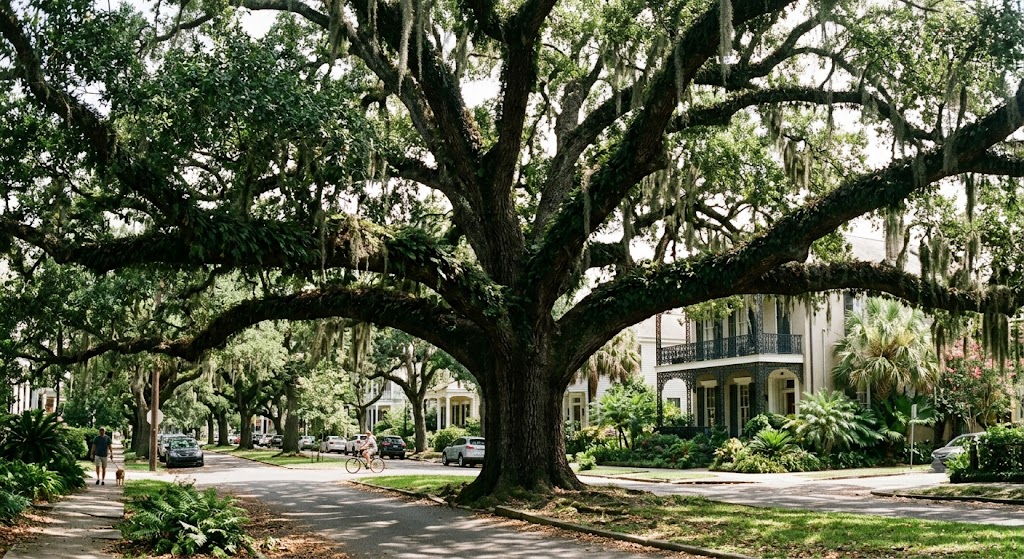
Live oaks and crape myrtles are signature trees across Greater New Orleans, from St. Charles Avenue and City Park to neighborhoods throughout Metairie, Kenner, and Jefferson Parish. While they often appear low-maintenance, hurricanes, high humidity, pests, disease pressure, and rapid seasonal growth make regular professional pruning essential for maintaining their health, structure, safety, and appearance. Delayed maintenance can allow small issues to become costly problems.
Key Takeaways
- Greater New Orleans sits in USDA hardiness zones 9a and 9b with a humid subtropical climate, a 6-month hurricane season, and high disease pressure that combine to make annual professional pruning of signature trees more than cosmetic.
- Live oaks (Quercus virginiana) develop massive horizontal limbs that, without proper structural pruning every one to three years, become catastrophic failure points in a major storm.
- Crape myrtles (Lagerstroemia species) require shaping and sucker removal every winter to produce healthy summer blooms and resist the bark scale infestations now confirmed across Louisiana.
- The most common pruning mistake homeowners make on crape myrtles in the region (severe topping, often called “crape murder”) permanently damages structure, reduces flowering, and shortens the tree’s productive life.
- The Atlantic hurricane season runs from June 1 through November 30 each year, making the late winter window the most important time for structural work on both species.
This article explains why annual professional pruning matters for these two species in particular, what proper care looks like, and what happens when it does not happen.
What Annual Pruning Actually Means
Annual pruning is not an aggressive cut every year. It is a yearly inspection and a targeted set of cuts based on what the tree needs that season. The work changes from year to year. Sometimes it is deadwood removal. Sometimes it is structural pruning of young limbs to set up long-term form. Sometimes it is canopy thinning to reduce wind sail before hurricane season. Sometimes it is clearance work over roofs or streets.
On a mature live oak, the work is often modest in any single year. The point is that nothing dangerous goes unaddressed for long. On a young or mid-life crape myrtle, the winter work is more substantial because shaping decisions made in the first 10 years define the tree’s structure for the rest of its life.
The International Society of Arboriculture publishes the standards that govern this work through the ANSI A300 pruning specification. Crews trained to A300 make cuts at the branch collar, never leave stubs, and never remove more than 25 percent of the live canopy in a single year on a mature tree.
Why Live Oaks Need Yearly Professional Attention
Live oaks are the longest-lived hardwoods native to the Gulf Coast. Some specimens in southern Louisiana have been documented at 500 years or older. Their structure is what makes them magnificent and what makes them dangerous when neglected.
The Horizontal Limb Problem
Live oaks send out long, heavy horizontal branches that can extend 40 to 60 feet from the trunk on mature specimens. Each of those limbs is a cantilever supporting hundreds or thousands of pounds of wood and foliage. The longer the limb, the more leverage acts on the union where it attaches to the trunk.
In a hurricane, that leverage multiplies under wind load. Limbs that have not been properly maintained develop:
- Included bark unions: Bark trapped between two large stems or between a limb and the trunk, weakening the structural connection
- Decay pockets: Cavities from improper old cuts, lightning strikes, or storm damage that compromise wood strength
- End-weight loading: Heavy foliage and water sprouts at the tip of long limbs, increasing leverage on the attachment
Structural pruning addresses these problems while limbs are still young enough to redirect. On a mature tree, cabling and bracing combined with periodic end-weight reduction can extend the safe life of a major limb for decades.
Disease and Pest Pressure on Greater New Orleans Live Oaks
Live oaks in southern Louisiana face several active pressures, documented by the LSU AgCenter and the USDA Forest Service Southern Region:
- Hypoxylon canker: A fungal disease that attacks stressed oaks, often appearing after drought or root damage. Annual inspections catch the silvery-gray fungal pads early.
- Mistletoe: A parasitic plant that draws water and nutrients from oak branches. Heavy infestations weaken limbs and reduce wind tolerance. Removal during dormant pruning is straightforward.
- Oak wilt: Less widespread in Louisiana than in central Texas, but the disease has continued moving east. Avoiding pruning during peak warm-weather sap flow reduces transmission risk.
- Oakleaf caterpillar: Periodic outbreaks can defoliate large oaks in a single season. Stressed, unpruned trees recover more slowly.
- Root issues from saturated soil: The high water table and seasonal flooding common in parts of Jefferson Parish stress oak root systems and make annual structural assessment more important.
A trained arborist on the property each year catches these problems while they can still be managed.
Why Crape Myrtles Need Yearly Professional Attention
Crape myrtles look forgiving. They tolerate poor soil, heat, and humidity, bloom heavily, and recover from harsh treatment. That apparent toughness is exactly why they are mistreated more than any other ornamental tree in Greater New Orleans.
The Topping Problem
The practice of cutting crape myrtle trunks back to the same heavy stubs every winter is so common across the South that it has a name: crape murder. It produces a tree that:
- Pushes out dense water sprouts that flower briefly but with weaker blooms
- Develops swollen knuckles at each cut point that fail over time
- Cannot develop the elegant, smooth trunk and exfoliating bark that define mature crape myrtles
- Becomes increasingly prone to disease and pest pressure as decay sets in around old cut points
Proper crape myrtle pruning is more selective. The work involves thinning crossing branches, removing suckers at the base, taking out small twiggy growth that produces little flowering, and shaping the canopy without amputating it. Done correctly, the tree develops sculptural multi-trunk form, smooth mottled bark, and stronger flowering year after year.
Crape Myrtle Bark Scale and Other Pests
Crape myrtle bark scale was first identified in the United States in 2004 in Texas and has since spread across the South. The LSU AgCenter has confirmed the pest in Louisiana. It produces a felted white covering on branches and trunks, followed by heavy black sooty mold from honeydew.
Annual winter pruning helps detect the scale early when populations are still manageable. Late-stage infestations require systemic insecticide treatment and aggressive sanitation. Other common problems include powdery mildew, Cercospora leaf spot, and aphids, all of which are easier to address on a properly thinned tree than on a dense, neglected one.
Live Oak vs Crape Myrtle Pruning Comparison
| Factor | Live Oak | Crape Myrtle |
| Best Pruning Window in Greater New Orleans | Late fall through winter dormancy | Late winter, February through early March |
| Pruning Frequency | Every 1–3 years, with annual inspections | Typically once each winter |
| Primary Goal | Structural strength, deadwood removal, and storm resilience | Canopy shaping, sucker control, and improved flowering |
| Common Mistake | Lion-tailing by removing too much interior growth | Severe topping, commonly called “crape murder” |
| Disease Concerns | Hypoxylon canker, mistletoe, and oak wilt | Crape myrtle bark scale, powdery mildew, and Cercospora leaf spot |
| Hurricane Risk if Neglected | High, especially from long overextended limbs | Generally lower, with more localized branch damage |
| Permit Considerations | May be protected as a heritage or regulated tree | Rarely subject to permitting requirements |
| Expected Lifespan with Proper Care | Approximately 200–500+ years | Approximately 50–100 years |