June 9, 2026
Key Takeaways
- Large dying trees present an exponential risk during hurricanes due to their immense mass, height, and high wind resistance.
- Louisiana’s high humidity and saturated coastal soils accelerate internal wood decay and root failure.
- Hidden structural defects like trunk hollows and root rot drastically lower a tree’s wind-load threshold.
- Proactive hazard identification and tree removal before tropical systems arrive are critical to prevent property damage.
- Hiring licensed, insured tree experts ensures that dangerous high-canopy removals are handled safely without risking nearby structures.
A severe storm, hidden decay, or structural weakness can quickly turn a healthy-looking tree into a serious hazard for homeowners in Southeast Louisiana ahead of the Atlantic hurricane season. While mature trees add shade and environmental value, they become dangerous liabilities when their structural integrity is compromised. The challenge is that damage and internal rot are not always obvious, and a tree that appears perfectly stable on the outside may already be actively failing internally.
A professional tree service company in New Orleans can assist you in making the decision to save or remove a large tree by conducting a careful assessment of structure, species, location, and recovery potential. Modern arboriculture provides effective tools to stabilize trees, but those methods are not universal solutions. In many cases, they can extend a tree’s life safely. In others, they only delay an unavoidable failure. Understanding the difference is essential in a storm-prone region like Greater New Orleans, where waiting too long can lead to catastrophic consequences.
The Physics of Failure: Mass and Height Risks
When a tropical system enters Southeast Louisiana, the physical loads applied to urban canopies increase exponentially. For a small tree, high winds cause minor leaf loss. For a mature tree, those wind forces transform the canopy into a massive sail, transmitting thousands of pounds of kinetic energy directly down the trunk.
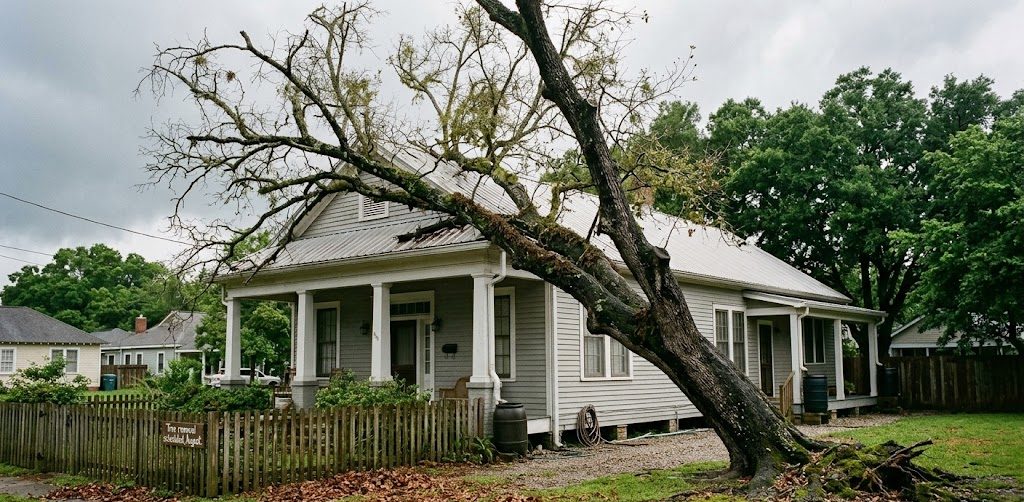
As a tree doubles in height, the leverage exerted on its base increases significantly. In a healthy tree, flexible wood fibers bend to dissipate wind energy. However, when a large tree is dying or rotting internally, it loses this elasticity. The wood becomes brittle, and the internal column of solid heartwood, the tree’s primary structural support, hollows out. When a tree weighs tens of thousands of pounds, sudden structural failure can crush roofs or down power lines.
Environmental Accelerants: The Gulf Coast Factor
In Southeast Louisiana, the timeline from initial tree sickness to absolute structural failure is short. This rapid decline is driven by the state’s unique subtropical climate. High relative humidity, persistent warmth, and abundant rainfall create an optimal environment for wood-decay fungi and subterranean termites.
Once a large tree is weakened by disease, fungal spores quickly colonize the exposed wood tissue. In Greater New Orleans, wood rot moves swiftly through susceptible species. Fungi break down the structural polymers that give wood its strength, leaving behind soft, brittle material that offers zero resistance to hurricane-force winds.
Furthermore, Louisiana’s coastal soils present a compounding hazard. During hurricane season, tropical storms saturate the ground. When the soil becomes waterlogged, the friction between the root system and the earth drops significantly. A large, dying tree with a compromised root system stands little chance when subjected to sustained winds in mud. The roots simply pull free from the liquefied earth, resulting in complete uprooting.
Identifying Warning Signs of Collapse
Homeowners must learn to spot the visual indicators that a large tree is in a state of advanced decline and poses an immediate threat before hurricane season peaks.
- Advanced Canopy Dieback: If the topmost branches are completely bare, brittle, or dropping bark, the tree is suffering from advanced dieback. This indicates that the root system or internal vascular tissue can no longer transport nutrients, making upper limbs highly prone to snapping under wind stress.
- Fungal Fruiting Bodies: The appearance of shelf-like mushrooms, or fungal conks, growing along the root flare or lower trunk is a definitive sign of advanced internal decay. These mushrooms indicate active underground fungal networks digesting the structural root system.
- Deep Vertical Cracks: Homeowners should inspect the trunk for deep vertical cracks that penetrate through the bark and into the wood fiber. These fissures often develop along old wounds or weak unions where codominant stems meet, signaling that the trunk is splitting under its own weight.
High-Risk Species in the Greater New Orleans Landscape
Not all tree species handle wind loads or decay in the same manner. In Southeast Louisiana, certain varieties of mature trees are notorious for high failure rates during severe weather events.
- Water Oaks (Quercus nigra): Unlike the resilient Southern Live Oak, Water Oaks are relatively short-lived trees that are highly susceptible to internal heart rot as they age. A mature water oak may look lush and green externally while its core is entirely hollowed out, making it prone to snapping during a hurricane.
- Pecan Trees (Carya illinoinensis): While valued for shade and fruit, mature pecans possess notoriously brittle wood. They are prone to sudden limb drop and extensive canopy breakage during high-wind events.
- Hackberry/Sugarberry (Celtis laevigata): These fast-growing trees have soft wood that decays rapidly once wounded. They frequently drop large scaffold limbs and are highly susceptible to wind-induced uprooting if their root zones are restricted.
Mitigation vs. Removal: Making the Safe Choice
When faced with a large, declining tree, property owners often wonder if the tree can be saved through interventions like crown reduction pruning, cabling, or bracing. While these modern arboricultural techniques are highly effective for preserving healthy trees that possess localized defects, they are fundamentally unsuited for trees in an advanced state of systemic decline.
Cabling can stabilize a weak branch union between two solid stems, but it cannot reinforce a trunk that is hollowed out by wood-decay fungi. Pruning can reduce wind resistance, but it cannot restore anchor roots that have already rotted away in waterlogged soil. Attempting to mitigate an intrinsically dying large tree near a home only provides a false sense of security, leaving the property highly vulnerable to the next major tropical system. In these severe cases, total tree removal is the only viable method to permanently eliminate the risk.
Protecting your home begins with understanding the true condition of your trees. A Perfect Cut Tree Service provides professional hazardous tree assessments and safe tree removal services throughout Metairie, Louisiana and the surrounding areas. Our ISA-certified arborists bring decades of local experience and specialize in managing storm-damaged and structurally compromised trees in Louisiana’s challenging climate.
Whether stabilizing a valuable mature oak or removing a hazardous tree after storm damage, A Perfect Cut Tree Service focuses on safety, accuracy, and long-term property protection. For inspections, emergency response, or scheduled evaluations, book a free estimate now with our team.
Frequently Asked Questions About Large Dying Trees and Louisiana Hurricane Season
Why do large dying trees pose a greater threat during a hurricane than smaller ones in Louisiana?
Large trees possess significantly more mass and height, creating an exponential leverage effect at their base. Their extensive canopies act like massive sails that catch wind, transferring catastrophic kinetic force to brittle, decaying wood structures.
Can a large tree look completely green on the outside but still be a high hurricane risk?
Yes. Certain species, particularly Water Oaks, can maintain green foliage in the outer canopy even while the interior trunk or major structural roots are hollowed out by wood-decay fungi or termites.
How does Louisiana’s coastal soil affect a dying tree’s stability in a storm?
Tropical systems bring immense rainfall that saturates the soil. When the ground becomes waterlogged, root-to-soil friction drops drastically. A tree with a rotting, dying root system can easily tip over completely, a failure known as windthrow.
What are the most dangerous visual signs of an impending tree collapse?
The most critical warning signs include advanced canopy dieback (bare upper branches), shelf-like mushrooms growing around the root flare, deep vertical splits in the trunk, and sudden ground-heaving or leaning.
Why are Water Oaks considered a high risk ahead of hurricane season?
Water Oaks are fast-growing, relatively short-lived trees with soft wood that is highly prone to internal rot. They frequently suffer from hidden heartwood decay, making them highly susceptible to snapping under hurricane-force winds.
Can crown reduction pruning save a dying tree from falling in a hurricane?
Pruning reduces wind resistance, but it cannot restore anchor roots that have rotted away or structurally reinforce a hollow trunk. If the decline is systemic, pruning only delays failure and does not eliminate the risk.
When should a large tree be removed instead of using cabling or bracing?
Cabling and bracing are only meant for structurally sound trees with localized weak unions. If a large tree has extensive internal rot, a hollow core, or an unstable root base, removal is the only safe option.
How quickly does wood rot progress in Louisiana’s subtropical climate?
The combination of high relative humidity, constant warmth, and high rainfall accelerates the spread of wood-decay fungi and termites, meaning a wounded or sick tree can lose its structural integrity much faster here than in drier climates.
Summary Checklist: When to Call for Removal
| Condition | Risk Level | Recommended Action |
|---|---|---|
| Sudden leaning after a storm | Critical | Emergency removal assessment immediately |
| Large trunk cracks into root flare | High | Professional inspection required ASAP |
| Extensive internal hollowing or decay | High | Tree likely unsafe; evaluate for removal |
| Fungal conks or mushrooms at the base | Moderate / High | Inspect for structural decay urgently |
| Visible termite damage in trunk or roots | High | Immediate arborist evaluation needed |
| Loss of more than 50% of the canopy | High | Reduced survival potential; consider removal |
| Overhanging structures or utility lines | Critical | Contact a licensed tree service immediately |
Final Advice
Deciding whether to preserve or remove a damaged tree is one of the most important responsibilities of property ownership in Southeast Louisiana. Many trees can be saved and even thrive for decades when structural issues are addressed early through pruning, cabling, or bracing. However, preservation is only appropriate when the tree still has a sound structural foundation and a realistic chance of long-term stability.
Once decay becomes extensive, roots fail, or trunk integrity is compromised, the risk of sudden collapse increases significantly, especially during the Louisiana hurricane season. Waiting too long often reduces options and increases danger to property and life. Early evaluation by a qualified arborist ensures that risks are identified before they escalate into emergencies.