May 14, 2026
Key Takeaways
- Storm Readiness is Vital: In the Gulf South, a tree that looks fine in sunshine can be a catastrophe during a hurricane.
- Root Flare Health: Mushrooms or heaving soil at the base indicate the foundation of the tree is failing.
- Structural Cracks: Deep vertical splits in the trunk are signs that the tree may soon pull apart.
- The Danger of Deadwood: Large dead branches, known as widow makers, can fall at any time without wind.
- Professional Diagnosis: Only a licensed arborist can accurately measure internal decay that is invisible to the naked eye.
New Orleans is famous for its canopy. From the majestic live oaks draped in Spanish moss to the towering pecans and magnolias, our trees are part of our cultural identity. However, living in the Crescent City means living with unique environmental challenges. Our high humidity, saturated alluvial soils, and the constant threat of tropical storms create a high-stress environment for urban trees.
As a homeowner, you have a legal and safety obligation to manage the trees on your property. A hazardous tree is defined as one with a structural defect that is likely to fail and cause damage to a target, whether that target is your house, your car, or a person. Because our trees grow so quickly in the Louisiana heat, they can hide internal rot behind a mask of green leaves. Understanding the warning signs of a failing tree is the first step in protecting your property.
In this guide, we will break down the five most critical red flags that indicate a tree has become a hazard. If you spot these on your property in Metairie, Kenner, or New Orleans, it is time to call in the experts.
1. Root Flare Decay and Fungal Growth
The most dangerous part of a tree is the part you cannot see: the root system. In New Orleans, our high-water table often leads to shallow root systems. When those roots begin to rot, the entire tree loses its anchor.
The Red Flag
Look at the base of the tree where the trunk meets the soil, known as the root flare. If you see mushrooms, shelf-like fungi (conks), or carton material created by termites, the tree is in trouble. These organisms feed on the cellulose and lignin that give the roots their strength.
Why It Is Dangerous
Fungal growth is the fruiting body of a much larger internal infection. By the time you see a mushroom, the root may already be as soft as a sponge. In a saturated soil environment like ours, a tree with root rot can simply pop out of the ground during a windstorm, a phenomenon known as uprooting. If you notice the soil on one side of the tree is mounding or heaving upward, the tree is likely already in the process of tipping.
2. Deep Vertical Trunk Cracks and Cavities
A tree trunk needs to be a solid pillar to support the massive weight of the upper canopy. When that pillar develops deep fissures, its structural integrity is compromised.
The Red Flag
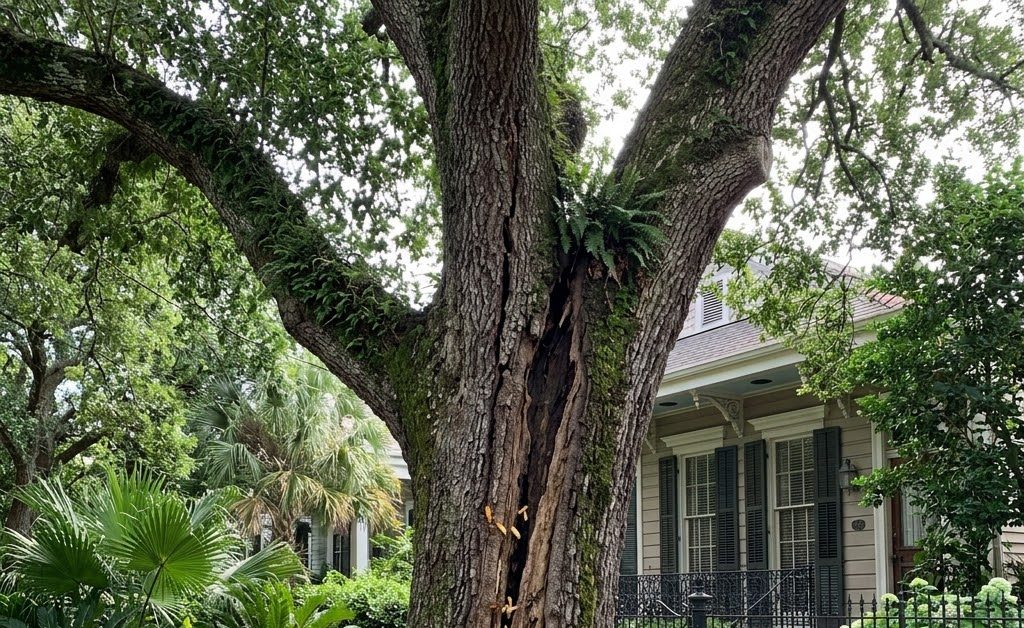
Small cracks in the bark are normal as a tree grows, but deep vertical splits that go through the bark and into the wood are major red flags. Similarly, large hollow cavities where limbs have fallen off or where rot has set in are indicators of a hollow tree.
Why It Is Dangerous
Vertical cracks often mean the tree is literally splitting in two. This is especially common in trees with included bark, where two trunks grow too close together in a V-shape. During a storm, the wind acts as a wedge, forcing those two halves apart. Cavities, on the other hand, reduce the shell thickness of the tree. If more than 30% of the trunk is hollow or decayed, the tree is at high risk of snapping in half under the pressure of hurricane-force winds.
3. Deadwood and Hanging Limbs
In the tree care industry, large dead branches are called widow makers for a reason. They are unpredictable and heavy.
The Red Flag
Look up into the canopy. Are there branches with no leaves while the rest of the tree is green? Do you see branches that have already snapped but are caught in the lower limbs? These are deadwood and hangers.
Why It Is Dangerous
Dead wood is brittle. It lacks the flexibility of living wood to bend with the wind. In New Orleans, our intense summer thunderstorms can easily send these heavy limbs crashing down onto roofs or power lines. Even on a calm day, gravity eventually wins, and these branches can fall without warning. Regular pruning to remove deadwood is the simplest way to reduce the sail area of a tree and make it safer during storm season.
4. Co-Dominant Trunks with V-Type Crotches
Not all hazards are caused by rot; some are caused by poor structural architecture.
The Red Flag
A co-dominant tree has two or more main trunks of similar size emerging from the same point. If the union between these trunks is shaped like a V rather than a U, it is a structural weak point.
Why It Is Dangerous
In a V-shaped union, the bark grows inward between the two trunks. This included bark prevents the two pieces of wood from actually bonding together. As the trunks grow larger, they push against each other, creating internal pressure. This is a primary failure point during tropical depressions. An arborist may be able to save such a tree through cabling and bracing, but left alone, it is a significant liability.
5. Sudden Leaning and Poor Canopy Balance
Trees naturally grow toward the light, often resulting in a slight lean. However, a change in the angle of a tree is a critical emergency.
The Red Flag
If a tree that was once straight is now leaning, or if the lean has noticeably increased after a heavy rain or wind event, the root system is failing. Additionally, look for unbalanced canopies where all the weight is on one side, often due to improper pruning or clearing for power lines.
Why It Is Dangerous
A leaning tree is fighting a losing battle against gravity. In the soft, wet soil of South Louisiana, a lean usually means the roots on the opposite side are snapping or pulling out of the earth. An unbalanced canopy creates a lever effect, putting immense torque on the trunk. If the weight is not redistributed through professional thinning and pruning, the tree will eventually succumb to the lopsided load.
Protecting your home from hazardous trees requires an expert eye and decades of local experience. At A Perfect Cut Tree Service, we provide comprehensive tree care in New Orleans, prioritizing tree preservation and health over simple removal. Our team features ISA Certified Arborists who bring 40 years of experience to every project, ensuring that your property is assessed with the highest industry standards. As the 2018 winner of New Orleans Homes Magazine’s Best Tree Service, we offer a noninvasive approach to maintenance that protects your roots and soil. Whether you need a hazardous tree assessment or storm prep. & support, or 24/7 emergency removal, every job is overseen by a licensed arborist for your peace of mind.
Give us a call at (504) 800-8266 for a free quote at our Metairie office, located at 4725 Shores Dr, and let us help you manage your landscape’s safety.
Frequently Asked Questions by Homeowners in New Orleans
1. Can a tree be a hazard even if it has green leaves in New Orleans?
Yes. Trees often maintain a green canopy even when they are 70% hollow or have significant root rot. The leaves only show that the plumbing is working, not that the structure is sound.
2. How close is too close for a tree to be to my house in New Orleans?
There is no set distance, but any tree with branches overhanging your roof or roots pushing against your foundation should be evaluated by an arborist.
3. Will my insurance pay for a hazardous tree removal in New Orleans?
Usually, no. Insurance typically only pays after a tree has fallen and caused damage. Proactive removal is considered maintenance and is the homeowner’s responsibility.
4. Can a leaning tree be straightened?
Rarely. Once a mature tree leans due to root failure, it is usually impossible to safely pull it back. Removal is often the only safe option to protect nearby structures.
5. What is included in bark?
This is bark that grows inside the crotch of a V-shaped union, preventing the wood from connecting and creating a weak point that is prone to splitting.
6. How often should New Orleans trees be inspected?
Given our storm frequency, a professional inspection every two years is recommended for mature trees, or immediately following any major wind event.
7. Is a hollow tree always a dead tree?
No. A tree can be hollow and live for decades. The danger lies in whether the remaining shell is thick enough to support the tree’s weight.
8. Can I prune a hazardous limb myself?
Large limbs require specialized rigging and safety equipment. Attempting to remove hazardous limbs yourself can result in serious injury or significant damage to your home.
Summary Checklist: Hazardous Tree Indicators
| Condition | Risk Level | Recommended Action |
|---|---|---|
| Mushrooms at the base | High | Arrange a professional inspection to evaluate root decay, internal deterioration, and structural stability |
| Deep trunk splits | Critical | Request an immediate structural assessment due to the elevated risk of trunk failure |
| Deadwood over 2 inches thick | Moderate | Schedule hazard pruning to remove unstable dead branches and reduce falling limb risk |
| Sudden new lean | Critical | Keep people clear of the fall zone and arrange for an emergency professional response immediately |
| V-shaped main union | High | Consult a qualified arborist regarding structural support or canopy load reduction strategies |
Final Advice
Identifying a hazardous tree early is the only way to prevent a manageable maintenance task from turning into a costly emergency. In New Orleans, the combination of old-growth trees and frequent extreme weather means that wait and see is a dangerous strategy. If you notice any of the red flags mentioned, especially fungal growth at the base or new trunk cracks, do not wait for the next hurricane to test the tree’s strength. Take proactive steps by keeping mulch away from the trunk flare and avoiding any root-zone construction that could invite rot. A professional assessment using tools like a sounding mallet or Resistograph can provide a clear picture of what is happening inside the wood.